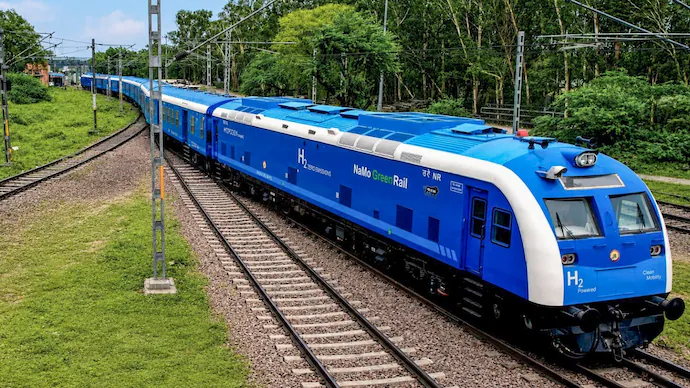
India has officially and fully transitioned into a select group of global nations operating hydrogen-powered rail systems following the inaugural launch of its first zero-emission passenger trainset. Operating along the 89-kilometer Jind-Sonipat broad-gauge corridor under the Northern Railway zone, the newly introduced green pilot project offers a highly sustainable, eco-friendly alternative to traditional diesel locomotives by generating traction power directly onboard.
The specialized broad-gauge trainset, comprising ten coaches designed to transport approximately 2,600 passengers daily, relies on a highly integrated 1,200 kW hydrogen fuel cell propulsion system. Approved for a top operational speed of 75 kmph despite a 110 kmph design threshold, the eco-friendly train connects crucial regional junctures including Jind Junction, Gohana Junction, and Sonipat while serving several designated rural stops. To ensure continuous daily operation, the project also incorporates an advanced, indigenously developed hydrogen storage and rapid refueling station in Jind.
Sharing his perspectives ahead of the ceremony, Prime Minister Narendra Modi noted, “India has become one of the select group of nations that have such trains. This will go a long way in ensuring that India adopts clean technology in the railway sector.” Officials plan to utilize key technical insights from this localized pilot run to refine future zero-emission rail retrofitting schemes across the national network framework.