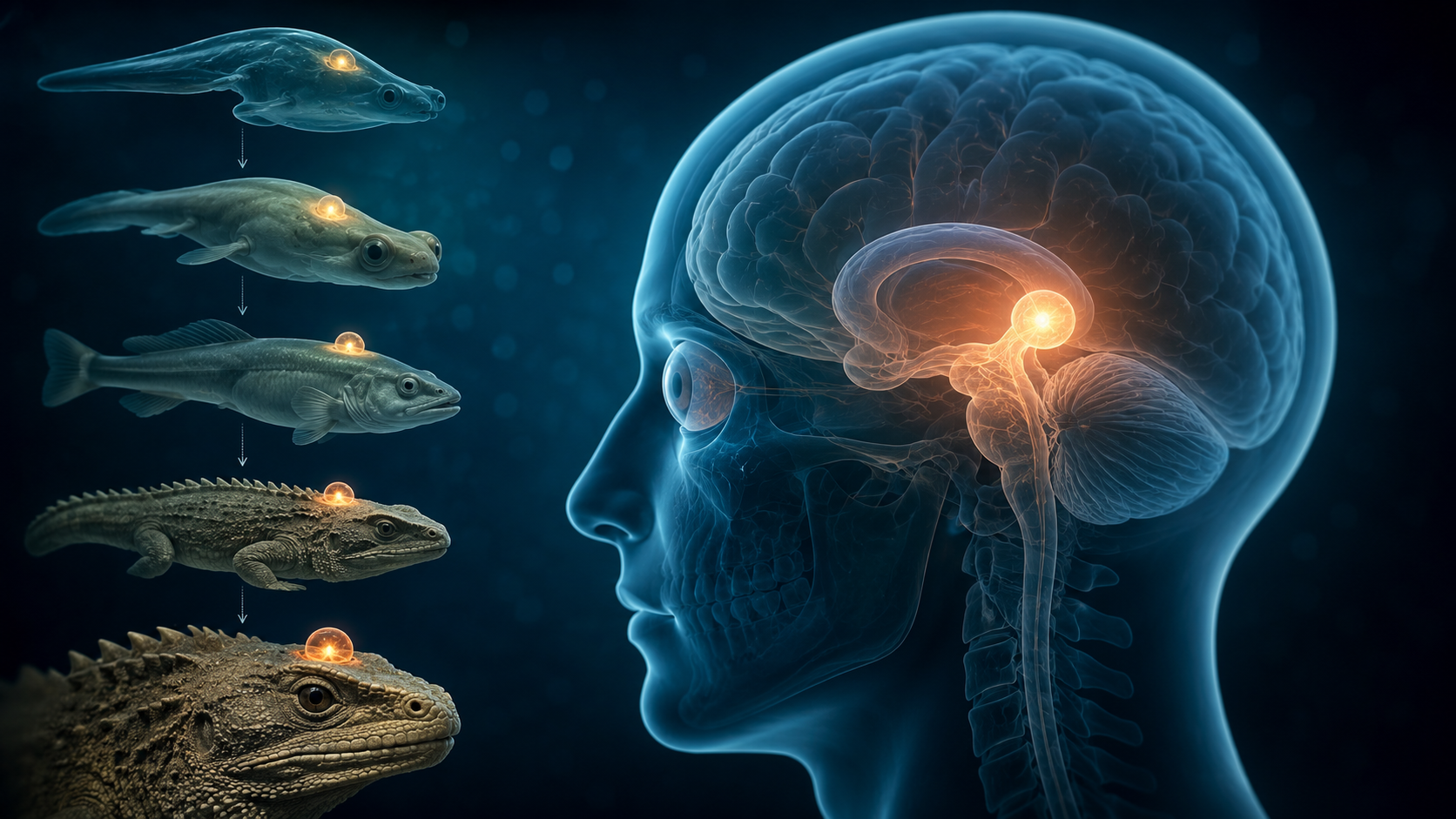
A groundbreaking study published in the journal Current Biology has revealed a shared evolutionary origin between the human retina and the pineal gland, tracing their roots back nearly 600 million years. Lead author Professor Thomas Baden explained that the research team sought to uncover the “original solution to vision” by mapping how different species modified light-sensing structures over deep time. Rather than conducting traditional physical experiments, the team analyzed a vast array of existing genetic data from ancient lineages, including lampreys and primitive fish.
The study outlines the “tri-cornea theory,” which posits that both modern retinas and the internalized pineal gland evolved from a single, ancient light-sensing organ in a sea-dwelling vertebrate ancestor dating to 575 million years ago. This ancestral creature possessed two lateral eyes for spatial navigation and a third, dorsally located organ to monitor ambient light levels. Over evolutionary epochs, as certain ancestral lines adapted to burrowing lifestyles, the lateral eyes withered, leaving the central organ to manage circadian orientation before parts of it later migrated outward to form modern retinas.
While the pea-sized human pineal gland is now deeply buried within the skull to manage melatonin and sleep cycles, some modern species retain its original structure. The New Zealand tuatara, for instance, still has a visible, functional third eye on top of its head to detect changes in light.