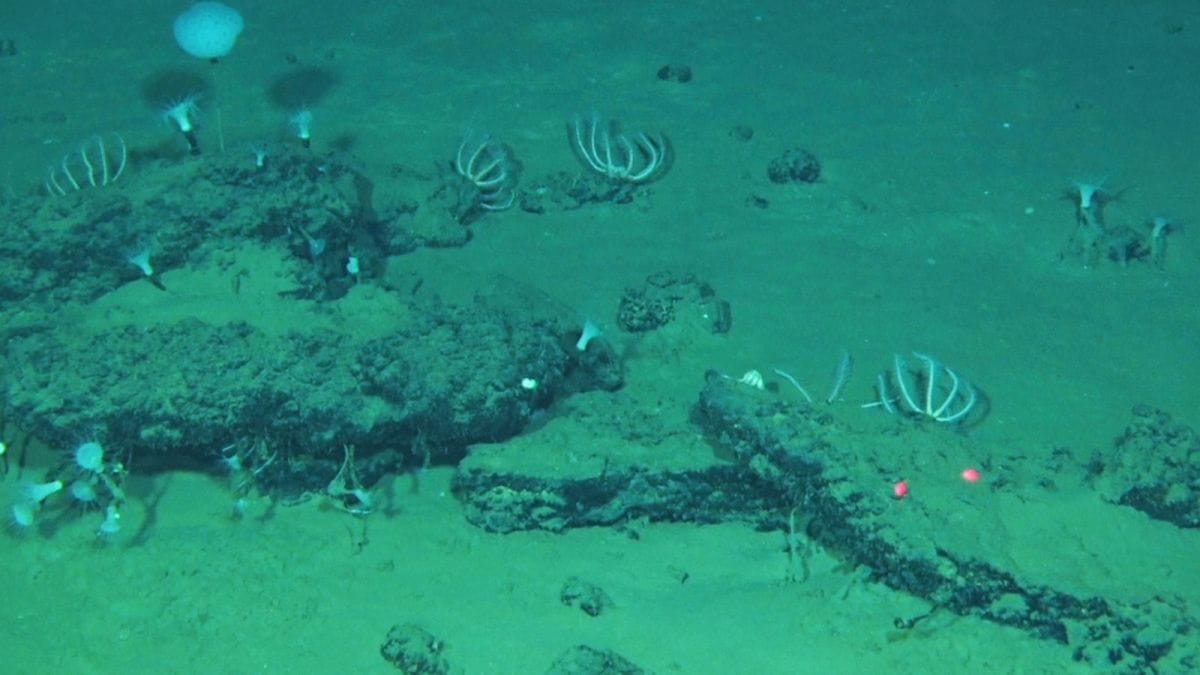
An international team of researchers from China, Italy, and New Zealand has discovered the world’s largest, deepest, and oldest whale graveyard at the bottom of the southeastern Indian Ocean. Detailed in the journal Nature, the vast “whale necropolis” stretches roughly 1,200 kilometers across the rugged Diamantina Fracture Zone west of Australia. The team estimates that the region contains over 10 million whale carcasses, which historically accumulated due to rich regional feeding grounds and a V-shaped trench system acting as a natural funnel.
The breakthrough was achieved during 32 deep-sea dives utilizing China’s crewed submersible Fendouzhe, descending nearly 7,000 meters below the surface to survey 485 fossil sites. Lead author Xiaotong Peng of the Chinese Academy of Sciences stated, “Discovering a necropolis of this scale was completely unexpected. The size of distribution, the depth and the age range were far beyond anything we had imagined.”
Recovered remains include the skull of a 5.3-million-year-old beaked whale species, Pterocetus benguelae, making it the oldest documented whale graveyard. Scientists also identified a newly discovered extinct species, naming it Pterocetus diamantinae. Beyond the paleonotological value, the decaying bones support thriving, unique ecosystems of crustaceans, bivalves, and bone-boring worms. The study estimates the organic matter sequesters 6.7 million tonnes of carbon, acting as an evolutionary stepping stone linking isolated deep-sea communities.
