SUMMARY
- Zoho launches Vikra and Zoho IoT to enhance digital commerce and IoT solutions for businesses.
- The company reported a 31% increase in its customer base in India during 2023.
- Financial performance includes over ₹500 crore in revenue and a 32.40% net worth increase.
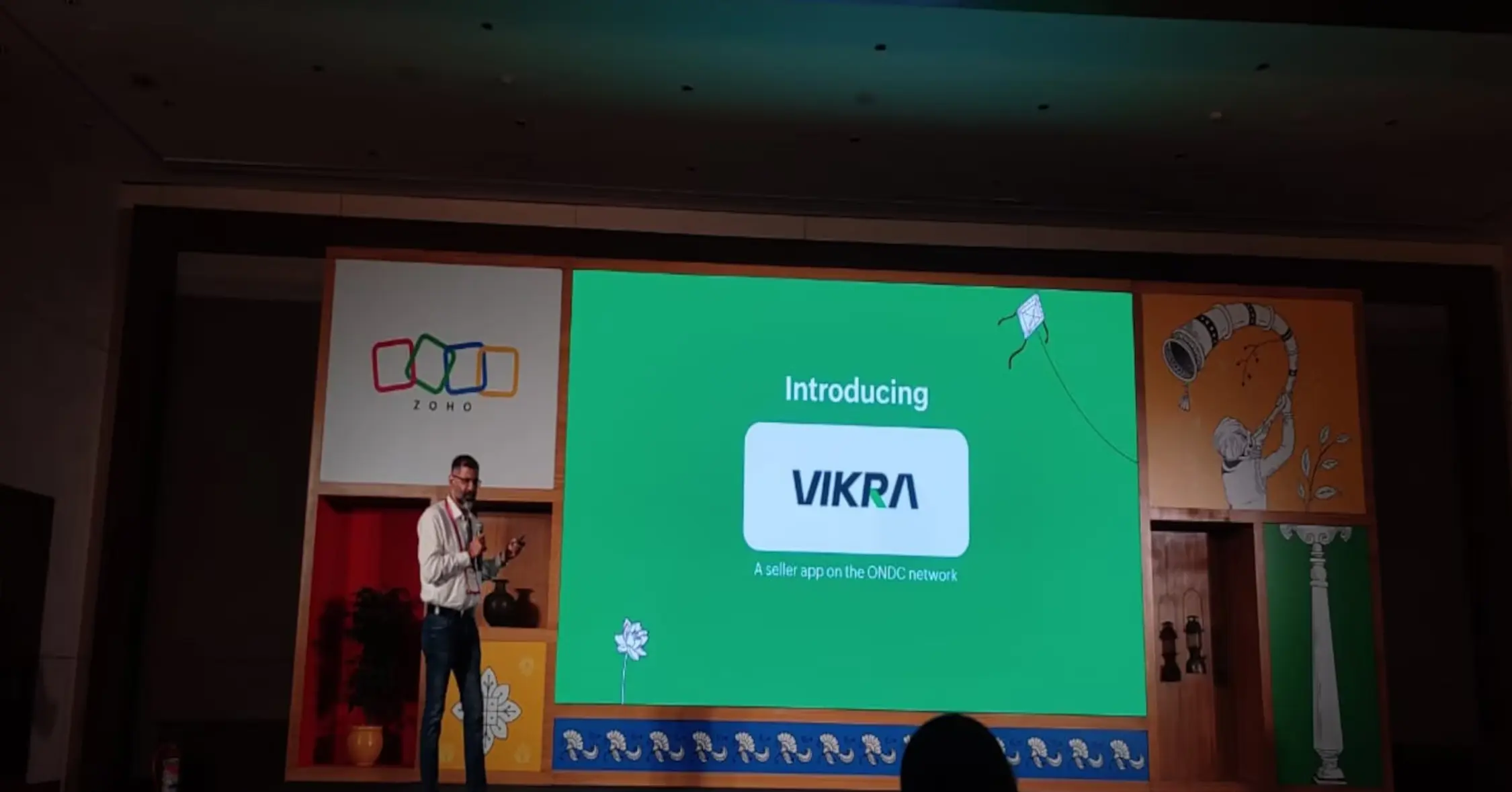
Chennai-based global tech company Zoho has launched Vikra, a seller application on the Open Network for Digital Commerce (ONDC), alongside Zoho IoT, a user-friendly low-code platform that enables businesses to create and deploy tailored Internet of Things (IoT) solutions. Additionally, the corporation reported that in 2023, its customer base in India increased by 31%. The announcements were made during the company’s yearly user conference, Zoholics India.
Co-founder and CEO of Zoho, Sridhar Vembu stated, “We remain steadfast in our product R&D efforts, with a focus on effectively enhancing our platform through innovating and launching new products like Vikra and Zoho IoT while also integrating AI capabilities across the tech stack. We have steadily advanced our contextual intelligence vision, applying AI technology to enhance customer experience and offer deeper insights. This commitment to continuous improvement is helping us become a preferred partner for large enterprises and government institutions across India. As businesses increasingly seek value from their software solutions and larger organizations aim to reduce bloat, we’re seeing significant growth in India, which has now become our second-largest market.”
Vikra is intended to serve as the vital link that links companies using the ONDC network to the huge market of India. This project not only carries on Zoho’s legacy of enabling companies but also expands its reach and streamlines market accessibility. Businesses that use the app may immediately start selling through well-known buyer applications like Paytm, Ola, and Snapdeal, set up stores, develop product catalogs, and easily become onboarded to the ONDC network.
MD and CEO of ONDC, Thampi Koshy said, “Vikra represents the kind of innovation that supports ONDC’s mission to make e-commerce accessible to all. By integrating such advanced solutions from Zoho, we are not just simplifying technology for businesses, we are also opening doors to a vast, inclusive digital economy. This is a step forward in democratizing e-commerce in India, where even the smallest businesses can now thrive in the digital marketplace harnessing the power of Technology.”
With Zoho IoT, businesses can benefit from real-time data collection and management of IoT devices, as well as streamlined operational analysis and insights. Because of its user-friendly features, organizations can easily automate processes and make data-driven choices without requiring a high level of technical experience. The AI features of the platform convert data into insights that may be put to use, forecast trends, identify anomalies or abnormalities, anticipate system breakdowns, manage operations, and improve user experiences.
The business is expanding its artificial intelligence (AI) capabilities by developing and implementing a range of language models narrow, small, medium, and large for distinct use cases across different products. With the addition of the crucial component, business context, the business’s approach to AI aims to assist organizations in gaining useful insights for decision-making. Additionally, the business places a high priority on privacy, making sure that no customer data is used to train AI models.
The Chennai-based global technology firm Zoho was founded in the year 1996 by Sridhar Vembu and Tony Thomas. It specializes in developing cloud-based software applications for businesses. Being one of the most successful technology businesses in the world, it has over 55 apps in almost every major business sector. With more than 15,000 workers, Zoho is a profitable privately held company with its headquarters located in Chennai, India.
For the financial year ending March 31, 2023, Zoho Corporation Private Limited reported revenue exceeding ₹500 crore, with a net worth increase of 32.40%. The company’s EBITDA rose by 9.61%, while total assets grew by 35.30%. However, liabilities saw a significant increase of 48.12%. The debt-to-equity ratio remains at 0.00, and the return on equity stands at 23.60%. Fixed assets increased by 71.48%, and current assets grew by 42.72%. Current liabilities rose by 48.12%, with trade receivables increasing by 128.03% and trade payables decreasing by 11.75%. The current ratio is reported at 3.03.