In 2022, the Indian food tech market was valued at Rs.959.16 billion and the valuation of this market is expected to reach over Rs.3509.50 billion by 2027 while expanding at a compound annual growth rate (CAGR) of 29.53% within the same period.
Currently, more than 3130 food tech startups are present in India, and these have bagged a significant amount of $4.6 billion as the total funding across 230 deals, according to the AgFunder Indian AgriFoodTech Investment Report 2022, in collaboration with venture capital firm Omnivore.
The exponential growth in technology adoption and the convenience of having food delivered to doorsteps have significantly contributed to the expansion of this market. The food tech market in India can broadly be divided into two segments – online food delivery and online grocery. As of 2022 reports, 60.66% of the overall revenue comes from the online food delivery segment of the Indian food tech market.
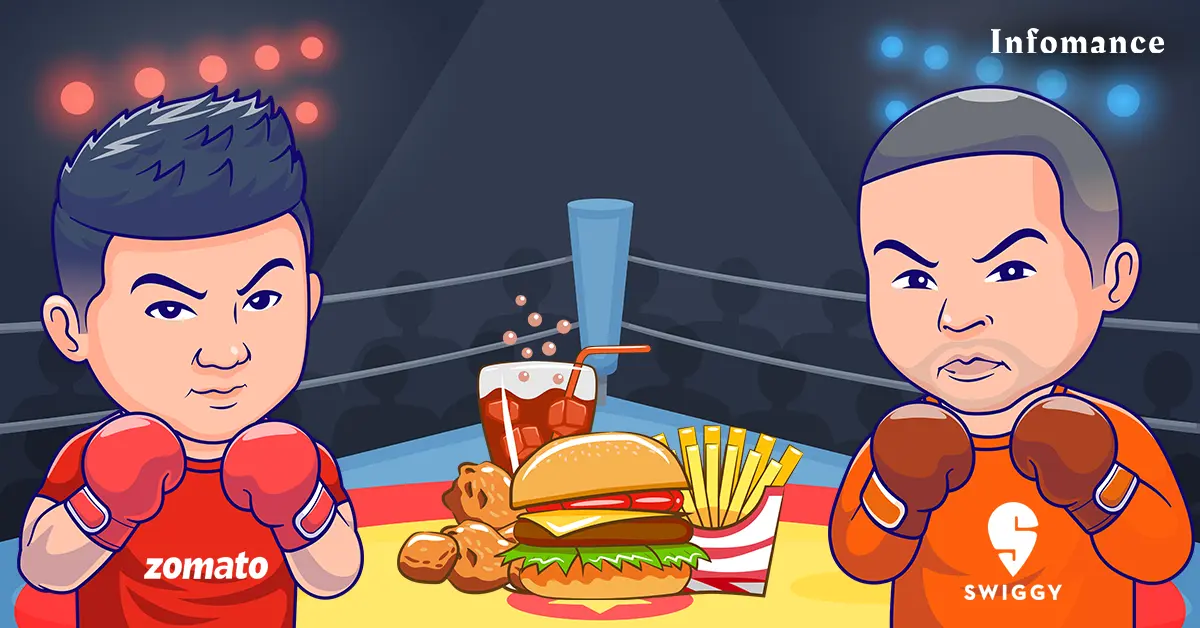
In India, the two biggest players in this sector are Swiggy and Zomato. Recent data reveals that Zomato’s total market share now stands at 57% as it has furiously expanded its business across food delivery and quick commerce segments. On the other hand, Baron Capital confirmed that Swiggy roughly owns 40% of the total market share in the Indian food delivery sector.
It is commonly recognized that these two rivals are inclined towards providing diversified services to their customers. Zomato has already established itself in quick-commerce as its scale is 50% larger than its competitors. Apart from the quick commerce platform BlinkIt, Zomato also operates several business units such as a food marketplace and Hyperpure. Following the same path Swiggy is also venturing into consumer electronics and different sectors to explore more of the e-commerce market with the 20-minute delivery plan.
Steering toward these companies’ income, in FY24 Zomato reported revenue of Rs.12114Cr. soaring by 71% from Rs.7079Cr. in FY23. Meanwhile, Food and grocery delivery startup, Swiggy’s revenue spiked by 35% from Rs.6119.8Cr. in FY22 to Rs.8265Cr.
in FY23. As filed, Zomato generated Rs.4206Cr. as its operating revenue in Q1FY25 while Swiggy recorded Rs.5476Cr. in the first 9 months of FY24. Food delivery aggregator, Zomato’s Q1 of FY25 results show immense growth by achieving a net profit of Rs.253Cr. compared to the net profit of Rs.2Cr. filed by Zomato during the same quarter in FY24. Amid this huge success, the company launched a new app named ‘District’, targeting the expanding ‘going out’ segment including shopping, watching movies, and staycations.
Although, In FY23 the company faced a net loss of Rs.971Cr. but it recovered in FY24 by showcasing a net profit of Rs.351Cr. In comparison, Zomato’s key rival, Swiggy unfortunately witnessed a net loss of Rs.4179Cr. and Rs.3629Cr. in FY23 and FY22 respectively.
Drifting the attention toward funds, reports revealed that Zomato has bagged a $1.79 billion fund while Swiggy has secured $3.6 billion as its total funding.
According to the annual report for FY24 by Prosus, over the same period, Swiggy’s combined gross order value (GOV) for food delivery and quick-commerce surged by 26% YoY, following Zomato’s growth of 31%.
Analysts further confirmed that Zomato employed 419000 active delivery partners as of December 2023, whereas Swiggy had only 387000 workers during the same time. Furthermore, Swiggy Instamart operated 487 active dark stores while Zomato-owned BlinkIt managed to launch 526 of them.
So, It is evident from these two rivals’ performances, that food tech Zomato has outpaced Swiggy across multiple dimensions. Hence reports have revealed that during FY24, Zomato achieved a steady 55.9% YoY growth, followed by Swiggy recording a stable 25%-30% year-on-year growth.
However, recent announcements from Zomato were highlighted in August 2024, that it will launch a new feature called ‘Order Scheduling’ to let the customers schedule their orders two days in advance as Deepinder Goyal, the company’s founder, confirmed this news through his official X (formerly known as Twitter) handle. As per the post, this new service will be provided to customers around 13,000 outlets in cities such as Mumbai, Delhi NCR, Bengaluru, etc.
Other developments are also unfolding since Zomato decided to own Paytm’s ticketing and entertainment businesses for more than $238 million. This deal indicates the food delivery platform’s pivoting strategy from home deliveries to out-going activities such as sports and concerts.
On the other hand, targeting Instamart business extension Swiggy is on the way to launching its IPO to raise $1 – $1.2 billion while aiming for a valuation of $15 billion. Swiggy has already received shareholder approval and is expecting the regulatory clearance soon.
Amid the business developments of Swiggy, a troubling news story emerged that could hurt the company’s image. A Reddit user from Lingampally Railway Station, Hyderabad, came across an odd situation after ordering from the supposed gourmet restaurant Olio, they found in the Swiggy listing for an outlet just 1 km away from their home, despite being certain no such restaurant existed nearby.
Nevertheless, in conclusion, we can say that even though these two food tech giants are fierce rivals, both are showcasing extraordinary dedication to seize every opportunity. Their competitive spirit drives continuous innovation and strategic growth, establishing them as the leading players in the industry. As they strive for market dominance, their efforts accentuate a commitment to excellence and a relentless endeavor for triumph.