Agriculture in India is one of the key contributors to our economy. It will be right if we refer to it as the backbone of our nation. The agriculture sector contributes roughly 14% of the country’s total Gross Domestic Product (GDP). Almost half of the population of India is indulged in agricultural activities. But again with so many irregularities in the climatic conditions of our nation and lack of rain farmers often find it difficult to produce the desired amount of products.There are a lot of hardships that people involved in agriculture-related practices experience.From lack of information about the market rates, less or no availability of good quality seeds, no place to stock the buffer, and so on. Hence, there was a need for the interlinkage of new-age technology with agricultural methods to improve the quality of output.
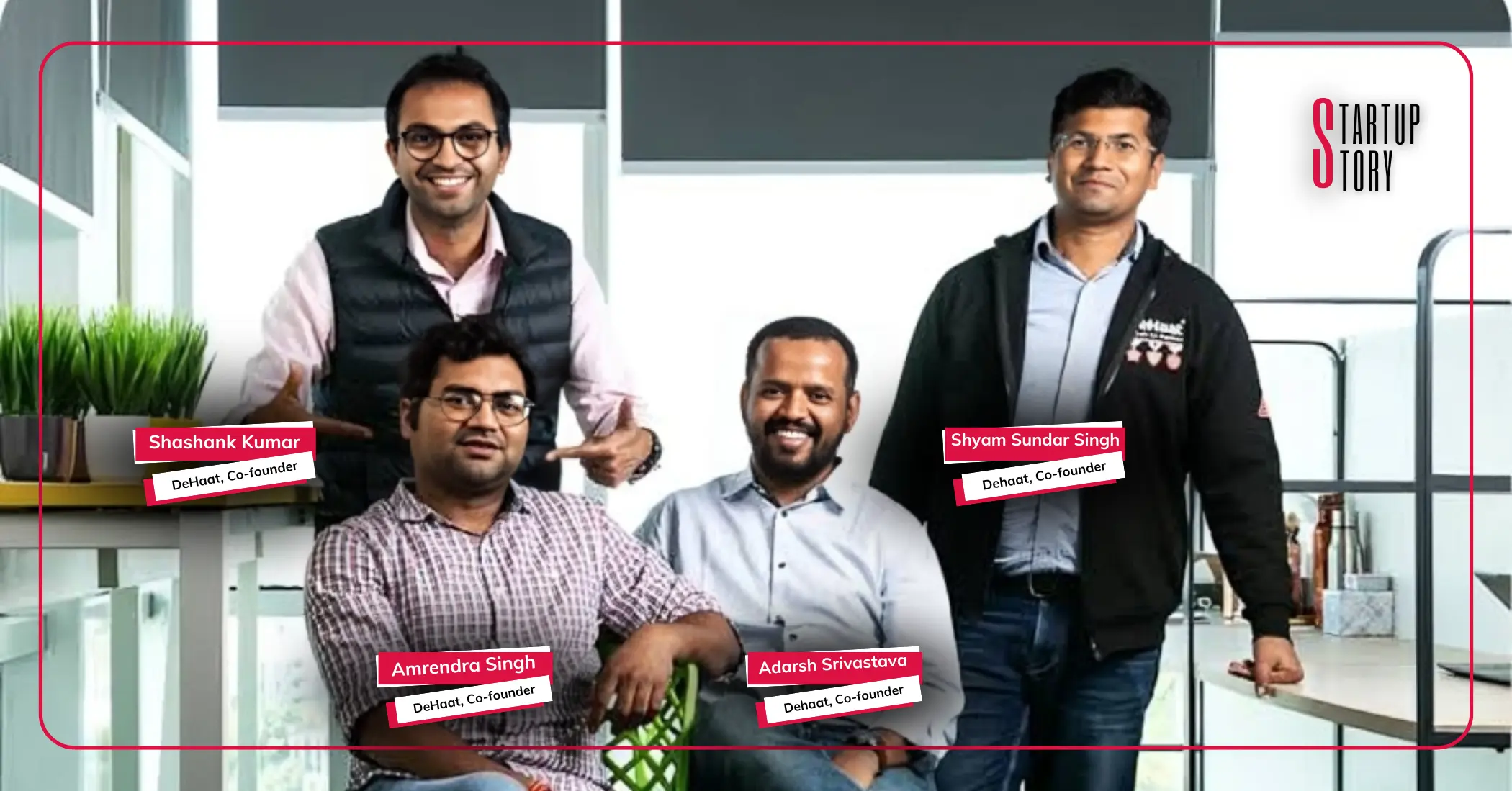
This same situation was observed by a bunch of ex-IITians namely Shashank Kumar, Amrendra Singh, Abhishek Dokania, Shyam Sundar Singh, and Adarsh Srivastava, as they came together to found an agritech startup aiming to provide farmers in rural India with access to information, products, and services that can help them improve their crop yields and incomes. The startup was named DeHaat which is the Hindi word for village.
Recent In News
India’s leading agritech startup DeHaat reported a 40% increase in its operating revenue as the revenue from operations in FY24 was ₹2,700Cr. It has also managed to reduce the losses by half.
First Traction
It may come as a surprise but in its early days, DeHaat started as a call center to connect with farmers and share information regarding weather patterns and crop prices. The firm’s first funding was announced on 1 June 2014. It was an angel investment and the amount remain undisclosed.
Year-over-Year Analysis
In 2020, the overall revenue stood at ₹125.8Cr and the growth rate observed was 195%. The Pune-headquartered firm has raised $7.28M by the end of FY20. The net loss incurred by the company in this year was ₹17.9Cr. It was valued at $34.5M in the FY19-20.
For the next fiscal year, the total revenue surged to ₹355.6Cr in 2021 from ₹125.8Cr in 2020. The growth rate reported was 182% which was just short of the 195% observed in the previous financial year. The valuation stood at $153M that year. A net loss of ₹442.6Cr was reported by the firm in FY21. The total funding raised by 2021 was $37.78M.
As of FY22, the gross revenue skyrocketed to ₹1,287.6Cr in FY21-22. A massive growth rate of 262% was observed in this financial year. The overall funding secured by the B2B-modeled firm was $212.78M. The company’s valuation stood at $520M in 2022. The overall loss reported was ₹1,564.1Cr.
In FY22-23, the firm reported its peak valuation of $700M in December 2022. The valuation later declined to $688M in January 2023. The overall revenue in this fiscal year was ₹1996.9Cr. A steady growth rate of 55% was reported in FY23. The firm didn’t manage to raise any funds this year. The net loss incurred by the SaaS-based firm was ₹1,094.4Cr.
For the next financial year, the firm has reported that its revenue from operations is ₹2,700Cr. The agritech startup has not announced any funding in the FY23-24 to date. The company has yet to file its financials with the Registrar of Companies (RoC) for this year. The owners aim to attain complete profitability by the end of FY25.
Expansion
One of the leading full-stack agritech platforms, DeHaat’s next aim remains to achieve EBITDA-level profitability. The company’s burn at the EBITDA level was 15% in FY23 which came down to 5% in FY23-24. It is also worth mentioning that the Pune-headquartered firm has doubled its presence across focus geographies from 53 hubs in FY22 to 103 in FY23.
Competitors
Alternatives of DeHaan, i.e. startups following the same business model or idea are Cropin, Vidhi, AgroStar, Krishiyog, Gramophone, and Origo Commodities. The B2C-modeled firm currently leads with a market share of 29%.
Acquisition
DeHaat has made 4 acquisitions as of now across sectors such as agritech, crop tech, and others. Its first acquisition came in 2021 when it complete a cash and stock deal to acquire FarmGuide, a B2B software as a Service (SaaS) firm for an undisclosed amount. In 2022, it infused $3.1M in YCook to acquire 75% of its stake. Earlier in the same year, the agritech startup to expand its presence in Western India acquired farm input startup Helicrifter. The deal value remains undisclosed. It acquired Freshtop Fruits’ export business for a lump sum of $9M in November last year.
