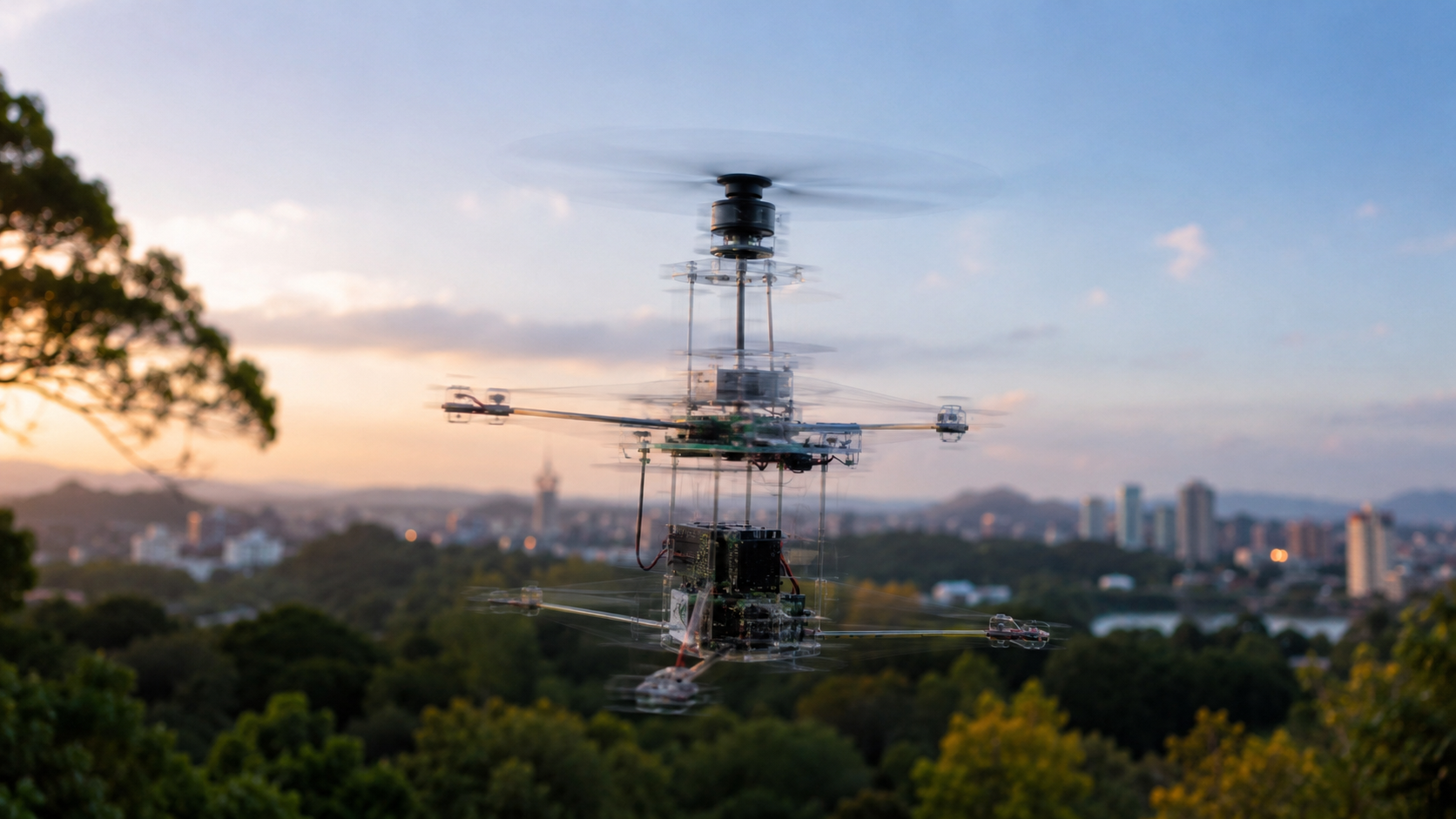
A major advancement in aerial design has emerged from the Robotics: Science and Systems 2026 conference in Sydney, where engineers introduced an optimization framework that drastically minimizes the visual signature of unmanned aerial vehicles (UAVs). Detailed in a paper titled “Computational Design of a Low-Visibility UAV Using Human-Aligned Perceptual Metric,” researchers from Northwestern University bypassed traditional, expensive camouflage systems like transparent panels or light-bending mirrors. Instead, they utilized a natural perceptual anomaly to dissolve an operating drone into a faint, semi-transparent haze against real-world backgrounds.
The resulting single-motor prototype, named the “Phantom Twist,” achieves an architectural layout where its core internal electronics—including wires, batteries, and circuit boards—are strategically separated at distinct angles and heights. During vertical ascent and sustained flight, the single propeller rotates in one direction while the entire structural chassis counter-rotates in the opposite direction at a rate of 25 revolutions per second. This rapid counter-rotation exploits the integration period of the human visual system. Because human eyes require brief intervals to compile light signals into sequential images, the distributed components blend into the surroundings via persistent motion blur rather than casting a solid, dark profile on the ground. According to the study’s integrated vision models, this configuration is nearly ten times less visually perceptible than standard four-rotor quadcopters.
Though engineering hurdles persist, including a distinct acoustic hum from the propeller and faintly visible structural rods, developers plan to mitigate these limitations by utilizing transparent structural plastics and sound-dampening modifications in subsequent prototype builds. The low-visibility mechanism offers significant utility for low-impact environmental monitoring, suburban civilian infrastructure inspections, and wildlife observation where disruptive machinery routinely scatters nesting species.