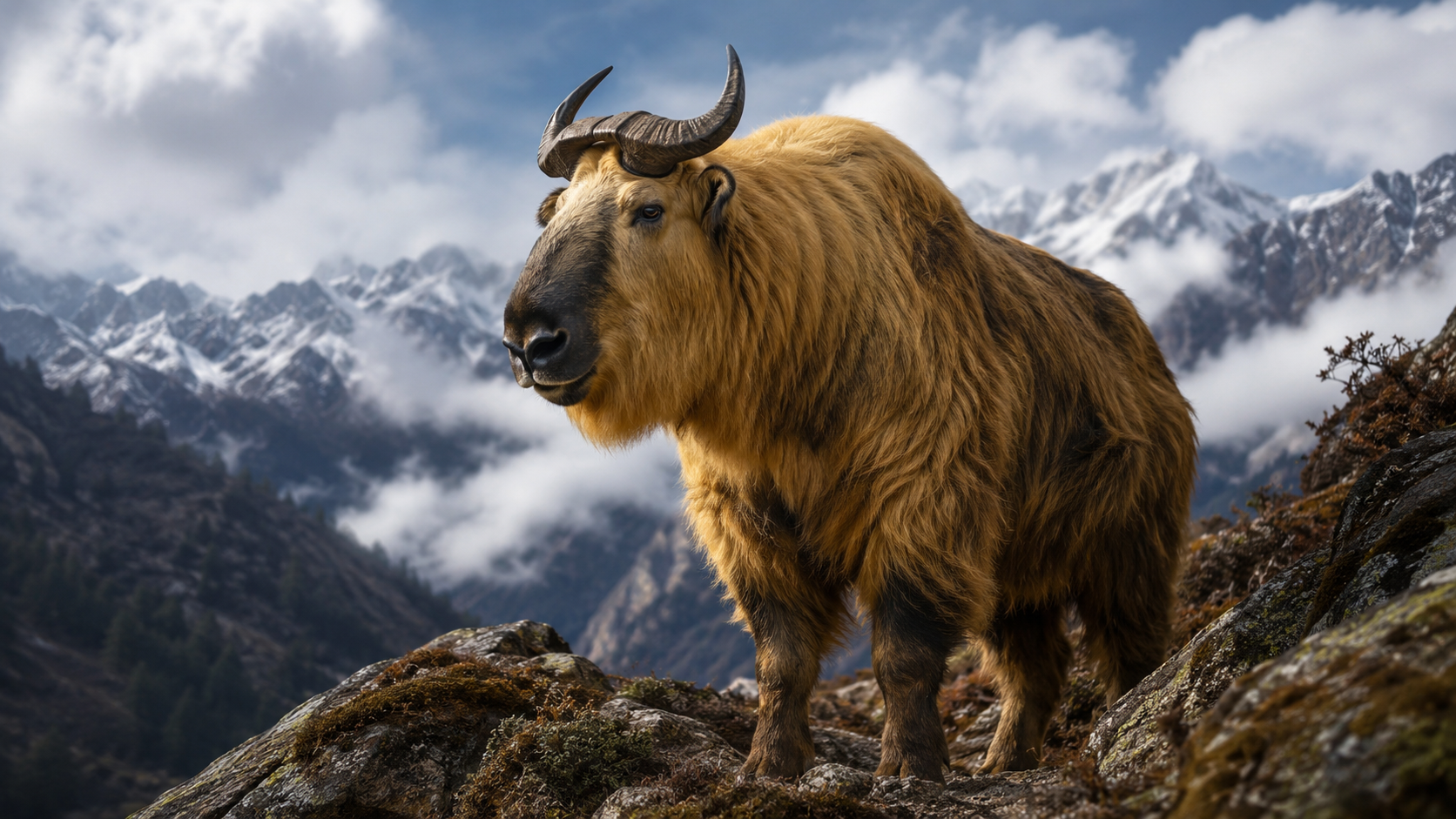
The takin is one of the world’s most unusual large mammals. With the body of a cow, the face of a moose, the horns of an antelope, and a shaggy golden coat, it has often been described as a creature that appears assembled from several different animals. Native to the mountainous regions of the Eastern Himalayas and southwestern China, the takin remains relatively unknown outside Asia despite being one of the largest wild mammals in its habitat.
Recent sightings in India’s Himalayan states have renewed interest in this remarkable species, which plays an important role in mountain ecosystems and has fascinated scientists for generations.
What Exactly Is a Takin?
The takin is a large hoofed mammal belonging to the species Budorcas taxicolor. It is the only living member of the genus Budorcas and belongs to the bovine family, making it more closely related to cattle, bison, sheep, goats, and antelopes than to deer.
Adult takins can weigh anywhere between 250 and 400 kilograms, while exceptionally large males may exceed 500 kilograms. Their stocky bodies, muscular shoulders, and thick fur allow them to survive harsh mountain climates where temperatures often fall well below freezing.
Who Discovered the Takin?
While local Himalayan and Chinese communities have known about takins for centuries, the animal became known to Western science during the nineteenth century.
The species was formally described in 1850 by British zoologist Brian Houghton Hodgson, who studied numerous Himalayan animals while stationed in Nepal. Hodgson’s work introduced the takin to the scientific community and helped establish its place within the bovine family.
Is the Takin Really a Cross Between a Cow and a Goat?
One of the most persistent myths surrounding the takin is that it is a hybrid between a cow and a goat.
This is completely false.
Takins are not hybrids and have never been scientifically linked to crossbreeding between cattle and goats. They are a distinct species that evolved naturally over millions of years.
The confusion arises because takins possess characteristics associated with both groups. They have the heavy build and broad muzzle typical of cattle, while their curved horns and mountain-climbing abilities resemble those of wild goats and sheep.
Modern genetic studies confirm that takins are a unique species within the bovine family and not the result of any crossbreeding.
Where Are Takins Found?
Takins inhabit a relatively narrow region of Asia.
Their range includes:
- Northeastern India
- Bhutan
- Northern Myanmar
- Southwestern China
- Eastern Himalayas
In India, takins are primarily found in the high-altitude forests and alpine regions of Arunachal Pradesh, particularly near the borders with Bhutan and Tibet.
Occasional sightings have also been recorded in remote Himalayan landscapes where suitable habitat remains intact.
Different Types of Takins
Scientists generally recognize four subspecies of takin:
- Mishmi Takin: Found mainly in Arunachal Pradesh, Tibet, and northern Myanmar.
- Bhutan Takin: Native to Bhutan and adjoining Himalayan regions.
- Golden Takin: Known for its striking golden-yellow coat and found mainly in China’s Qinling Mountains.
- Sichuan Takin: Distributed across mountainous areas of Sichuan and neighboring provinces in China.
Among these, the Golden Takin is often considered the most visually spectacular due to its bright coloration.
Why Do Takins Look So Unusual?
The takin’s appearance is the result of adaptation to mountain life.
Several features help it survive:
- Thick oily fur provides insulation against snow and rain.
- Large lungs assist breathing at high altitudes.
- Strong legs enable movement across steep slopes.
- Broad hooves provide stability on rocky terrain.
- Powerful shoulder muscles help navigate dense vegetation.
The animal’s enlarged nasal passages may also help warm cold mountain air before it reaches the lungs.
What Do Takins Eat?
Takins are herbivores.
Their diet includes:
- Bamboo shoots
- Leaves
- Grasses
- Herbs
- Shrubs
- Tree bark
- Twigs
- Seasonal flowers
They use their flexible tongues and strong mouths to strip vegetation from branches.
During winter, when fresh vegetation becomes scarce, they often rely on woody plants and bark to survive.
How Do Takins Live?
Takins are social animals that typically live in herds.
During much of the year, females and young form groups that may range from a few individuals to several dozen animals.
Adult males often remain solitary outside the breeding season and join herds only during mating periods.
These animals are highly mobile and undertake seasonal migrations between elevations, moving to higher alpine meadows during summer and descending into forests during winter.
Are Takins Dangerous?
Takins are generally shy and avoid humans. However, they are extremely powerful animals and can become dangerous if threatened, cornered, or protecting young. Their size, muscular build, and sharp horns make them capable of defending themselves against predators such as leopards, wolves, and other large carnivores.
Wild takins should always be observed from a safe distance.
What Predators Hunt Takins?
Depending on location and age, takins may be preyed upon by:
- Leopards
- Snow leopards
- Wolves
- Dholes
- Large bears
Young calves are particularly vulnerable, whereas healthy adults have relatively few natural predators because of their immense size.
Conservation Status
The takin is currently classified as Takin by the International Union for Conservation of Nature.
Major threats include:
- Habitat loss
- Forest fragmentation
- Illegal hunting
- Human encroachment
- Infrastructure development in mountain regions
Protected areas across India, Bhutan, and China play a crucial role in safeguarding remaining populations.
Cultural Importance
The takin holds special cultural significance in Bhutan, where it is recognized as the country’s national animal.
According to Bhutanese folklore, the animal was created by the revered Buddhist saint Drukpa Kunley, often known as the “Divine Madman.” The legend remains one of the most famous wildlife stories in the Himalayan region.
Conclusion
The takin is one of Asia’s most extraordinary mammals—a species that combines immense strength, remarkable mountain adaptations, and a unique evolutionary history. Despite often being described as a cross between a cow and a goat, it is actually a distinct member of the bovine family that has evolved to thrive in some of the world’s most challenging environments.
From the mist-covered forests of Arunachal Pradesh to the rugged mountains of Bhutan and China, the takin remains a symbol of the Eastern Himalayas’ rich biodiversity and a reminder of how much of the natural world remains unfamiliar to many people.
