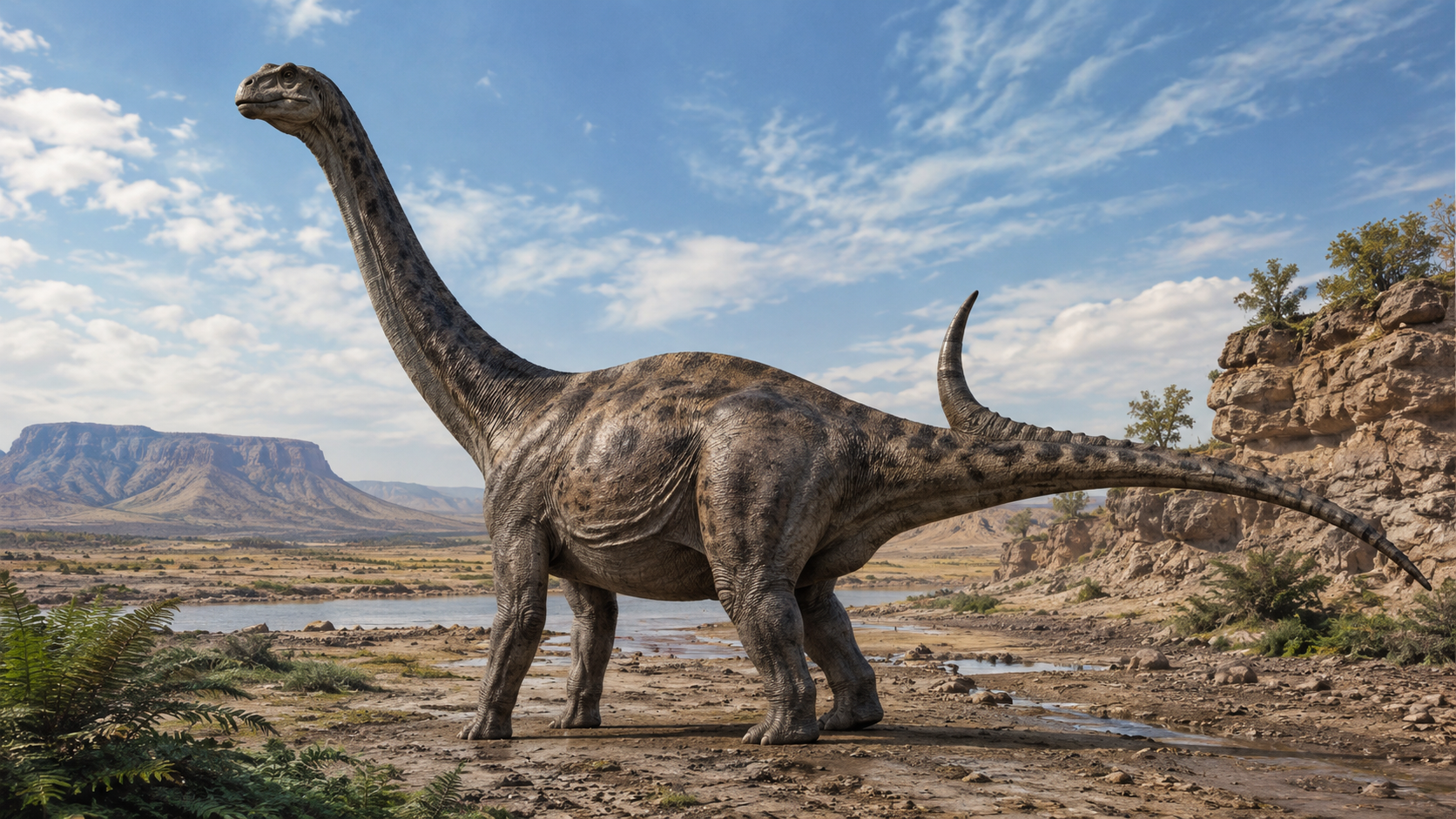
Paleontologists excavating Gujarat’s Kaladongar Formation in the Kachchh Basin have identified a novel species of long-necked dinosaur possessing a distinct defensive adaptation. Named Ceratocaudia antiqua (“ancient horned tail”), the small-statured macronarian sauropod measured roughly seven meters in length—significantly smaller than its 20-meter relatives like Brachiosaurus—and lived approximately 170 to 180 million years ago during the Jurassic period.
The species is distinguished by a prominent curved, horn-like crest atop its front tailbones, a unique neck vertebra notch, and rare “ball-and-socket” tail joints near the tip. Advanced 3D laser scanning and CT technology performed on the partial skeleton excavated near Amrapar village revealed signs of extensive bone remodeling and ancient leg arthritis, confirming the creature was an elderly individual rather than a growing juvenile.
The collaborative research by scientists from the Indian Institute of Technology Bombay (IIT Bombay) and the Birbal Sahni Institute of Palaeosciences marks the earliest diagnosable member of its lineage in India. The discovery proves that macronarian dinosaurs had already dispersed globally much earlier than previously recognized, filling a crucial gap in the Indian Jurassic fossil record.