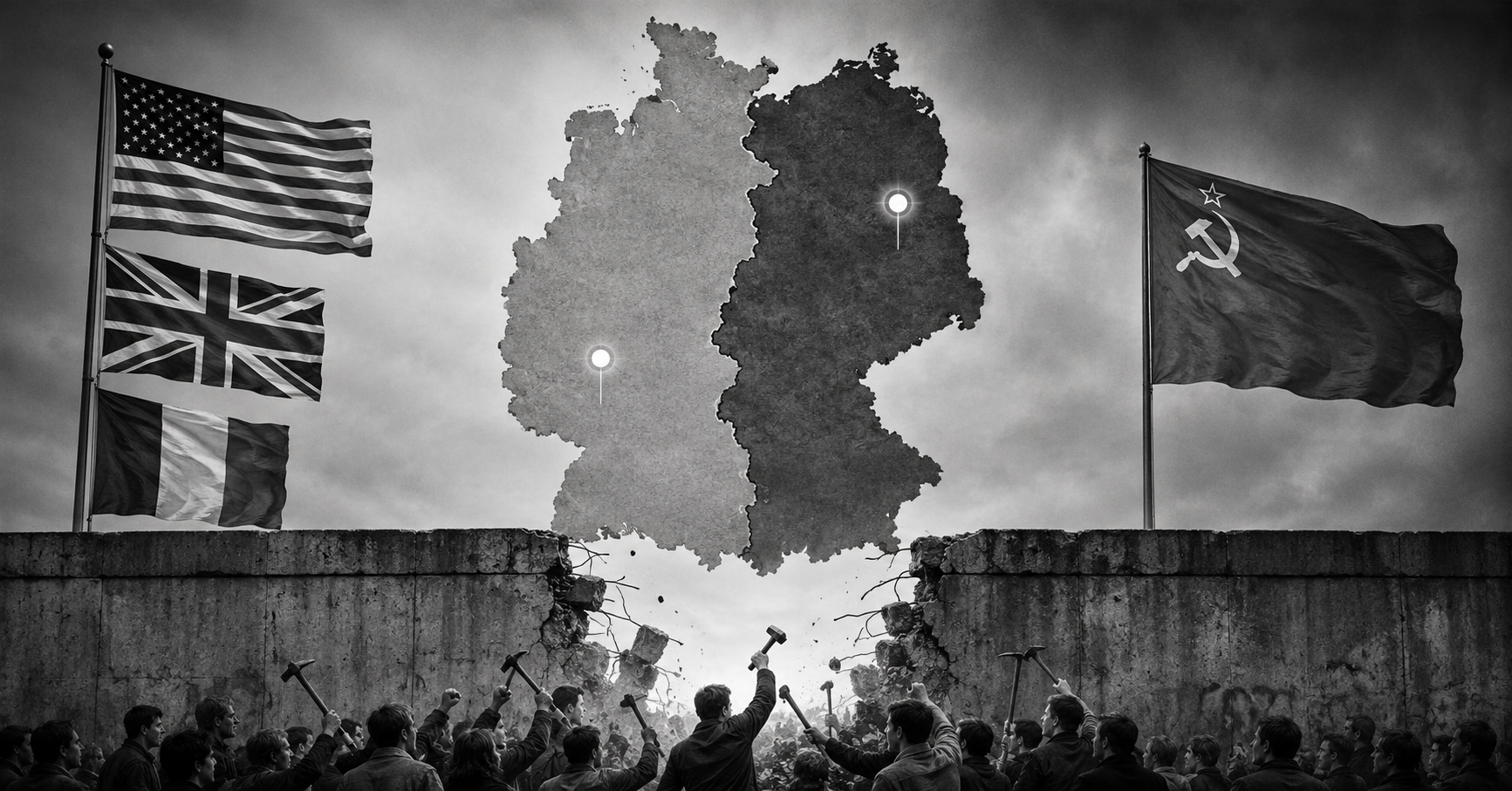
Yes, partially it is true! There was a time when Berlin was not the capital of Germany but Bonn, which is located in North Rhine-Westphalia, was the capital of Germany.
However Bonn was the capital of Germany only between 1949 and 1991. Before and after this period, Berlin was and is the capital of Germany.
Now let’s understand how this change happened in history.
So after Germany surrendered in World War 2, Germany was divided into 4 occupation zones:
- Southwestern Germany (Freiburg, Saarbrücken)
- Northwestern Germany (Hamburg, Hanover)
- Southern Germany (Munich, Frankfurt)
- Eastern Germany (Dresden, Leipzig)
These zones were occupied by France, the United Kingdom, the United States and the Soviet Union respectively. This division was later reorganized into 2 zones because of the Cold war.
- West Germany – American + British + French zones
- East Germany – Soviet Union Zone
What about Berlin?
Berlin was also divided into 4 sectors, even though it was located entirely inside the Soviet Union zone.
- American Sector
- British Sector
- French Sector
- Soviet Sector
Later this division became:
- West Berlin – American + British + French sectors
- East Berlin – Soviet sector
And because of this division, West Berlin became an unstable location for the government of West Germany so they needed a safer capital. So in 1949, the Federal Republic of Germany was created and the government started looking for a new capital that:
- Was entirely inside West Germany
- Was secure and easy to govern from
- Was not under the influence of Soviet Union
And Bonn was the city that matched all the requirements.
However, Bonn was chosen as a temporary capital because the West German government did not want Germany to remain divided into 4 parts forever, and this is how Bonn became the Provisional Capital of Germany.
After Bonn became the capital of West Germany, Berlin remained divided into 2 sectors due to the Cold War.
- East Berlin served as the capital of East Germany
- And West Germany was governed from Bonn
The Berlin Wall
Between 1949 and 1961, almost 3.5 million people fled from East Germany to West Germany and to stop this migration, East Germany came up with an idea of constructing a huge wall that separated East and West Berlin physically.
The Berlin Wall was
- About 155 mm in length
- About 11.8 feet in height
The Fall of the Berlin Wall
On 9 November 1989, The Berlin Wall fell because of the public protests and growing demand for freedom across East Germany along with democratic movements in Eastern Europe that put immense pressure on the communist government, eventually it lifted all the restrictions.
The Reunification of Germany
On 3 October 1990, East and West Germany officially reunified as a single country.
The Capital Berlin
On 20 June 1991, the German parliament voted to move the capital from Bonn back to Berlin. From 1991 to 1999, everything from Parliament to ministries and government offices gradually relocated from Bonn to Berlin. In 1999, Berlin officially became the working seat of the German federal government and parliament once again.
What Happened with Bonn
After the capital moved back to Berlin in 1999, Bonn remained a key federal city, retaining several government ministries, hosting numerous UN organizations, and continuing as an important political and international hub.
Timeline
- 1945: Germany defeated and divided into 4 occupation zones.
- 1948–49: Relations between the Western Allies and the Soviet Union deteriorated.
- 1949: West Germany and East Germany were established.
- 1961: The Berlin Wall was built.
- 1989: The Berlin Wall fell.
- 1990: Germany was reunified.