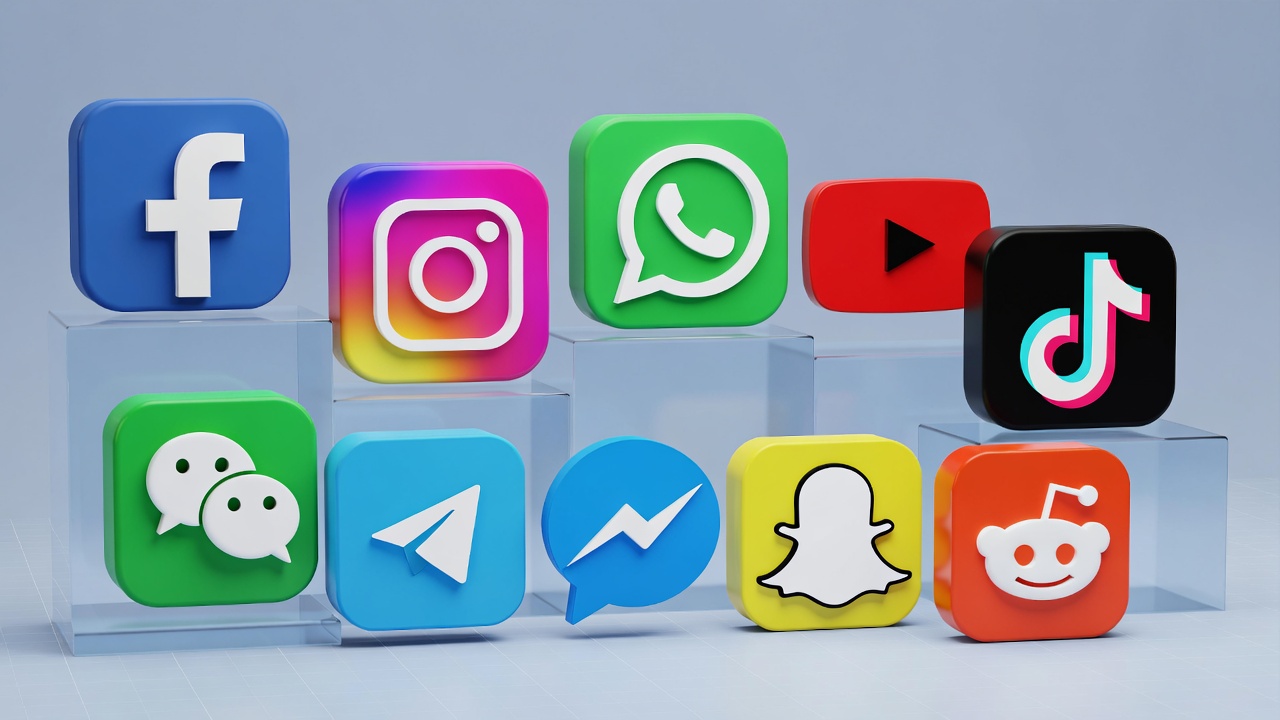
Social media has become an integral part of global communication, entertainment, business, and community building. In 2026, billions of people around the world use social platforms every day to stay connected, share content, learn, shop, and even build careers. With data continually updated by research agencies like Statista, Prioridata, and other industry trackers, we know which platforms are the biggest and most widely used worldwide.
This article lists the top 10 social media platforms in 2026 based on monthly active users (MAUs) — the primary global metric to measure platform popularity and reach. All user figures are up-to-date, cross-checked, and verified.
1) Facebook: ~3.07 Billion Monthly Active Users
Facebook remains the most-used social media platform in the world, with approximately 3.07 billion users logging in each month. Its global reach spans all continents and demographics, with extensive features including News Feed, Groups, Pages, Marketplace, and integrated messaging.
Facebook remains a dominant hub for personal communication, community engagement, and business marketing.
Global reach, extensive features, strong business ecosystem.
2) Instagram: ~3.00 Billion Monthly Active Users
Instagram, a visual-first platform owned by Meta, has around 3.0 billion monthly active users. It is one of the fastest-growing social apps, particularly popular among young users and creators.
Instagram’s focus on photos, Reels, Stories, and influencer culture has made it an essential platform for lifestyle content, brand promotions, and creator monetisation.
Vibrant visual content + strong creator economy = massive global growth.
3) WhatsApp: ~3.00 Billion Monthly Active Users
WhatsApp stands shoulder-to-shoulder with Facebook and Instagram, also boasting around 3.0 billion monthly active users. It continues to be the go-to messenger app for personal, professional, and small business communication across the world.
The app’s end-to-end encryption, group features, voice/video calls, and business chat tools help maintain its massive user base.
Messaging simplicity + global adoption = unstoppable usage.
4) YouTube: ~2.7 Billion Monthly Active Users
YouTube, the world’s premier video platform, has about 2.7 billion monthly active users. From short clips to long-form videos, tutorials, music, documentaries, and live streams, YouTube remains the definitive destination for video content.
Creators, advertisers, educators, and entertainers all use YouTube, making it a central pillar of the global social media ecosystem.
The largest video content platform on the planet.
5) TikTok: ~1.6 Billion Monthly Active Users
TikTok has grown explosively to nearly 1.6 billion monthly users. Its algorithm-driven feed of short, highly engaging videos has resonated around the world, especially with younger audiences.
TikTok has shaped trends in music, fashion, education, humor, and more, and its impact on global culture continues to grow.
Short-form video + addictive algorithm boost engagement.
6) WeChat:~1.41 Billion Monthly Active Users
WeChat is one of the most widely used platforms in China and among Chinese communities worldwide, with approximately 1.41 billion monthly users. What sets WeChat apart is its all-in-one ecosystem — messaging, social networking, payments, mini-programs, and services all built into one app.
It is used as a daily utility platform, not just messaging or social networking.
Utility + social + commerce = massive adoption.
7) Telegram: ~1.00 Billion Monthly Active Users
Telegram has recently crossed the 1 billion user mark, reflecting strong growth driven by privacy-oriented messaging, large group/community features, channels, file sharing, and bot integrations.
Telegram is especially popular with users who prefer secure communication, community networking, and large-scale channel broadcasting.
Privacy focus + powerful features drive adoption growth.
8) Facebook Messenger:~1 Billion Monthly Active Users
Facebook Messenger, Meta’s standalone messaging app, has around 1 billion monthly users. It remains one of the top messaging platforms globally, linked directly to Facebook’s ecosystem but also widely used independently.
Messenger’s integration with business messaging, chat features, video calling, and cross-app compatibility continues to keep it near the top of global social usage lists.
Part of the Meta ecosystem with strong messaging adoption.
9) Snapchat: ~900-943 Million Monthly Active Users
Snapchat has continued its strong presence and innovation in social media, reporting around 900-943 million monthly active users. Known for its ephemeral Stories, AR lenses, Snap Originals, and youth-centric culture, Snapchat remains especially popular among younger demographics.
The app continues to innovate in augmented reality and short-form social experiences.
Ephemeral social + AR features = lasting appeal.
10) Reddit: ~765 Million Monthly Active Users
Reddit, with about 765 million monthly active users, rounds out the top 10. Unlike traditional social networks focused on personal timelines, Reddit is structured around communities — known as subreddits — where users share news, ideas, questions, and discussions on nearly every topic imaginable.
It’s a social platform based on interest-driven engagement rather than personal profiles.
Community discussions drive deep engagement.
Honourable Mentions
Although not in the top 10, the following platforms have large global footprints:
- Pinterest — ~620 million users: Visual discovery and inspiration.
- X (formerly Twitter) — ~550-600 million users: Real-time information and micro-blogging.
- Douyin — ~750-800 million users: China-specific equivalent of TikTok.
These platforms remain key parts of the global landscape.
As of 2025, more than 5 billion people use social media globally, making it one of the most transformative digital forces in history. Facebook, Instagram, and WhatsApp dominate user counts, while platforms like TikTok, YouTube, Telegram,m and WeChat illustrate how diverse formats, video, messaging, and communities shape modern online life.
Social media continues to evolve, with new trends in AI integration, commerce, creator monetisation, augmented reality, and virtual communities driving the next generation of digital interaction.
