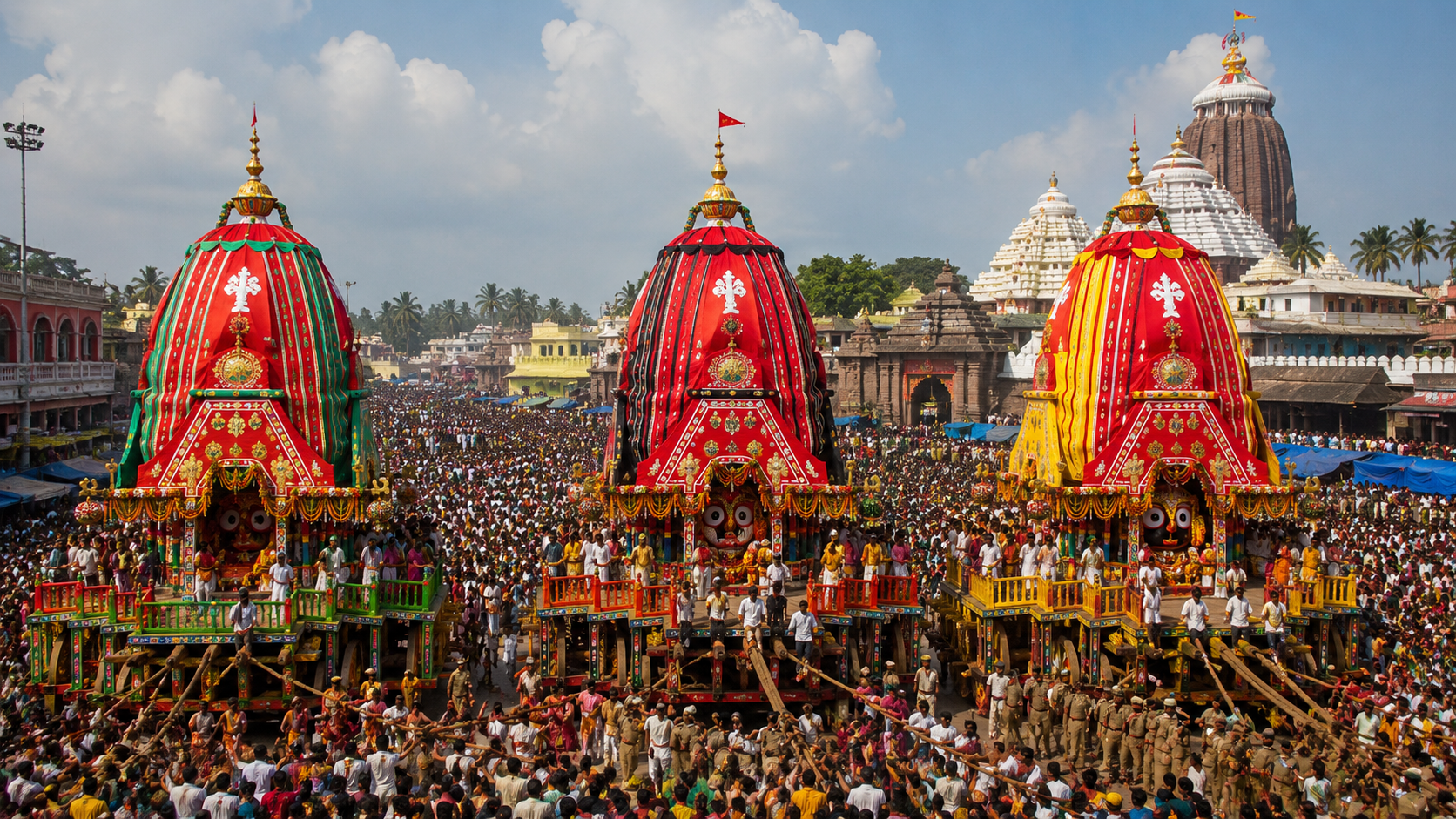
Every year, millions of devotees gather in the coastal city of Puri in Odisha to witness one of the world’s largest and oldest religious processions—the Rath Yatra, or Festival of Chariots. During this grand celebration, Lord Jagannath, along with his elder brother Lord Balabhadra and younger sister Goddess Subhadra, leaves the sanctum of the Jagannath Temple and travels through the streets on magnificent wooden chariots. Unlike most Hindu temples where the deity remains inside the temple premises, Rath Yatra symbolizes the Lord stepping out to bless every devotee without distinction of caste, creed, or social status.
Today, Rath Yatra is celebrated across India and in dozens of countries worldwide. However, its spiritual home remains Puri, where centuries-old traditions continue almost exactly as they have for generations. The festival is deeply connected with Odisha’s history, the Jagannath tradition, ancient Hindu scriptures,s and one of India’s most remarkable temple cultures.
Who Is Lord Jagannath?
Lord Jagannath is revered as a form of Lord Vishnu and Lord Krishna in the Vaishnava tradition. The word “Jagannath” comes from Sanskrit:
- Jagat = Universe
- Nath = Lord
Together, Jagannath means “Lord of the Universe.”
Unlike conventional Hindu idols carved from stone or metal, the idols of Lord Jagannath, Lord Balabhadra and Goddess Subhadra are made from sacred neem wood, known as Daru Brahma. Their distinctive large round eyes, simplified facial features, es and unfinished limbs make them among the most recognizable religious icons in the world.
The Historical Evolution of the Jagannath Tradition
The Jagannath tradition developed over many centuries and reflects the blending of tribal, regional, and Vaishnava worship traditions.
Historical records and temple traditions indicate that early forms of Jagannath worship were associated with the worship of Nilamadhava, a form of Lord Vishnu revered by the Sabara (Sora) tribal community of Odisha. Later traditions describe King Indradyumna learning about Nilamadhava and establishing formal worship at Purushottama Kshetra (present-day Puri). These accounts are preserved in texts such as the Skanda Purana, Brahma Purana, and other traditional literature.
The present-day Jagannath Temple was built during the 12th century under the Eastern Ganga ruler King Anantavarman Chodaganga Deva, with later additions completed by his successors. Since then, the temple has remained one of Hinduism’s four sacred Char Dham pilgrimage sites.
Why Do the Idols Look Different?
One of the most frequently asked questions is why Lord Jagannath and his siblings have unfinished arms and legs.
Temple tradition explains that King Indradyumna commissioned the divine craftsman Vishvakarma to carve the idols on the condition that he would not interrupt the work. Before the images were completed, the king opened the workshop door. As a result, the deities remained in their unfinished form, which has continued to be worshipped ever since.
This account forms part of the temple’s traditional history and devotional literature. Regardless of interpretation, the unique appearance has become one of the defining features of Jagannath worship.
What Is Rath Yatra?
Rath Yatra literally means “Chariot Journey.”
It is the annual procession in which Lord Jagannath, Lord Balabhadra, Goddess Subhadra and the Sudarshana Chakra leave the Jagannath Temple and travel approximately three kilometres along Puri’s Grand Road (Bada Danda) to the Gundicha Temple.
Unlike ordinary temple processions, Rath Yatra allows everyone—regardless of whether they can enter the temple—to have darshan of the deities. This openness is one reason the festival is regarded as a celebration of equality, devotion, and inclusiveness.
Why Is Rath Yatra Celebrated?
According to Jagannath tradition, the annual journey commemorates Lord Jagannath’s visit to the Gundicha Temple, which is regarded as the garden retreat associated with King Indradyumna’s queen, Gundicha.
The journey also symbolizes the Lord coming out among the people, blessing devotees directly rather than waiting for them to enter the temple. This concept has made Rath Yatra one of Hinduism’s most accessible and widely attended religious festivals.
When Is Rath Yatra Celebrated?
Rath Yatra is observed every year on the Dwitiya (second day) of the bright fortnight (Shukla Paksha) in the Hindu month of Ashadha, which generally falls in June or July according to the Gregorian calendar.
Although the date changes annually, the sequence of rituals remains unchanged.
The Three Deities
The procession includes three principal deities:
- Lord Jagannath – Regarded as the Lord of the Universe and a form of Vishnu/Krishna.
- Lord Balabhadra – Elder brother of Jagannath, symbolizing strength and righteousness.
- Goddess Subhadra – Younger sister of Jagannath and Balabhadra, representing compassion and auspiciousness.
The Sudarshana Chakra also accompanies the procession as an integral part of the Jagannath tradition.