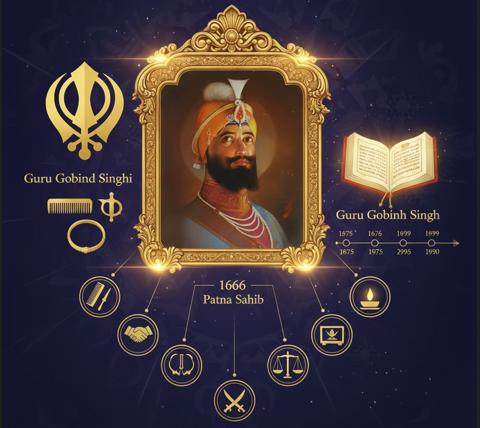
Guru Gobind Singh Jayanti is one of the most significant commemorative days in Sikh tradition. It marks the birth anniversary of Guru Gobind Singh, the tenth and final human Guru of Sikhism. The day is observed to remember his life, teachings, sacrifices, and enduring contributions to spiritual thought, social justice, and ethical living. For those unfamiliar with Sikh history, understanding this day provides a complete picture of why Guru Gobind Singh remains a towering historical and spiritual figure in India’s civilisational landscape.
What Is Guru Gobind Singh Jayanti?
Guru Gobind Singh Jayanti is the annual observance of the birth of Guru Gobind Singh. Unlike many festivals fixed to the Gregorian calendar, this Jayanti is traditionally calculated using the Nanaksahi and Hindu lunar calendar systems, which is why its Gregorian date may vary year to year.
The day is observed with prayers, religious gatherings, recitation of hymns, and reflections on the Guru’s life and teachings.
When Is Guru Gobind Singh Jayanti Celebrated?
Guru Gobind Singh Jayanti is observed annually in December or January, depending on traditional lunar calendar calculations.
Guru Gobind Singh Ji was born in December 1666, and for this reason, many modern references mention 27 December as his birth date in the Gregorian calendar. However, the actual celebration date varies each year, and Sikh communities observe the Jayanti according to traditional calendrical calculations rather than fixed English date.
Who Was Guru Gobind Singh?
Guru Gobind Singh was the tenth Sikh Guru, a spiritual leader, philosopher, poet, warrior, and reformer. He assumed the Guruship at a very young age after the martyrdom of his father, Guru Tegh Bahadur.
He is remembered not only as a religious leader but also as a historical figure who stood firmly against injustice, oppression, and forced conversions, while advocating dignity, courage, and moral responsibility.
Early Life and Birth
- Born: December 1666
- Birthplace: Patna Sahib, Bihar
- Father: Guru Tegh Bahadur (Ninth Sikh Guru)
- Mother: Mata Gujri
From childhood, Guru Gobind Singh was trained in philosophy, languages, poetry, martial skills, and spiritual discipline. His upbringing reflected a balance between intellectual depth and physical preparedness.
Becoming the Tenth Guru
Guru Gobind Singh became the Sikh Guru in 1675, at the age of nine, following the execution of his father by Mughal authorities for defending religious freedom. This event profoundly shaped his worldview and mission.
Rather than responding with fear, he strengthened the Sikh community’s moral courage and collective identity.
Major Contributions and Achievements
Creation of the Khalsa (1699)
One of Guru Gobind Singh’s most transformative acts was the establishment of the Khalsa on the festival of Vaisakhi in 1699. The Khalsa represented a community of initiated Sikhs committed to:
- Truth
- Justice
- Equality
- Fearlessness
- Moral discipline
He introduced the Five Ks, external symbols representing internal values of faith and responsibility.
Advocate of Equality
Guru Gobind Singh strongly rejected caste discrimination and social hierarchy. His teachings emphasized that all humans are equal, regardless of birth, status, or background.
Scholar and Poet
He was a prolific writer and poet, composing works in multiple languages. His writings addressed spirituality, ethics, courage, and the eternal struggle between righteousness and injustice.
Role as a Warrior and Leader
Guru Gobind Singh is often remembered as a warrior, but his use of force was defensive, not expansionist. He believed that when all peaceful means fail, standing against tyranny becomes a moral duty.
His leadership inspired resilience, self-respect, and collective responsibility among his followers.
Family Sacrifices
Guru Gobind Singh’s life was marked by immense personal loss:
- All four of his sons were martyred at a young age.
- His mother, Mata Gujri, also died during imprisonment.
Despite these tragedies, he remained unwavering in his principles, placing duty and justice above personal grief.
Declaring the Guru Granth Sahib as the Eternal Guru
Before his death, Guru Gobind Singh made a historic decision. He declared that no human Guru would succeed him. Instead, he bestowed eternal Guruship upon the Guru Granth Sahib, the Sikh holy scripture.
This ensured that Sikh guidance would remain rooted in divine wisdom rather than individual authority.
Death and Legacy
Guru Gobind Singh passed away in 1708 at Nanded, in present-day Maharashtra. His death marked the end of the line of human Sikh Gurus but the continuation of Sikh spiritual authority through scripture.
His legacy endures through Sikh institutions, values, and the global Sikh community.
How Guru Gobind Singh Jayanti Is Celebrated
On this day, devotees observe the occasion through:
- Early morning prayers
- Recitation of Sikh hymns
- Kirtans and religious discourses
- Processions known as Nagar Kirtans
- Community service and charity
- Langar (community meals) symbolizes equality
The focus remains on remembrance, reflection, and ethical living rather than ritual alone.
Why Guru Gobind Singh Jayanti Matters Today
The relevance of Guru Gobind Singh extends far beyond religious boundaries. His life offers lessons in:
- Standing up for freedom of belief
- Moral courage in adversity
- Equality and social justice
- Responsibility toward society
In an era of division and conflict, his teachings continue to inspire unity, resilience, and ethical action.
Guru Gobind Singh Jayanti is not merely a remembrance of a historical birth but a celebration of values that remain timeless. Guru Gobind Singh’s life combined spirituality with action, compassion with courage, and faith with responsibility. Understanding this day offers a complete insight into why he is revered as one of India’s most influential spiritual and historical figures.
For anyone encountering this topic for the first time, Guru Gobind Singh Jayanti serves as a poignant reminder that true leadership is grounded in sacrifice, integrity, and an unwavering commitment to justice.