SUMMARY
- IIM Sambalpur admits 363 students with 51.24% engineers, 75% with work experience, and 33% women representation.
- The MBA-BA batch has 100% industry experience, 61.7% engineers, and includes students from nearly all Indian states.
- Director Prof. Jaiswal emphasized digital, inclusive, and sustainable education, aligning with India’s Viksit Bharat 2047 vision.
IIM Sambalpur, one of the most progressive and fast-growing IIMs in the country, renowned for setting standards, continues to uphold its commitment towards academic excellence and diversity. In the latest admissions cycle for the academic year (2025–2027), IIM Sambalpur has reported a slight increase of 5% in the number of engineers admitted compared to non-engineers.
This development is evident across both its newly launched MBA in Business Analytics programme as well as the 11th batch of its flagship MBA Programme for 2025–27. In alignment with IIM Sambalpur’s core values – Inclusivity, Integrity and Innovation, IIM Sambalpur’s incoming MBA batch also comprises three students with physical and mobility challenges.
Of the total 363 graduates admitted across both the MBA programmes, 186, which constitutes 51.24% of the batch, hold engineering degrees. While non-engineer students account for the remaining 48.76%. The preference for a technical background is evident in the MBA in Business Analytics (MBA-BA) programme, where the engineering cohort comprises 61.70%.
However, the flagship MBA programme reports a near-equal distribution, with 49.68% of graduates from engineering and 50.32% from non-engineering students. Additionally, the MBA-BA cohort stands out for its industry readiness, as 100% of the cohort possess prior work experience, thereby increasing the practical orientation and applicability of the programme in the evolving business environment. Complementing this academic spread is healthy gender diversity: the incoming batch is 33% female and 67% male overall, with the flagship MBA classroom showing 38% women and 62% men, while the MBA-BA pioneers include 5% women and 95% men.
Disciplinary variety stretches well beyond engineering—around 20% of students hold commerce and accountancy degrees, 9% come from pure sciences, 8% from management-related courses and 4% from the arts, with the remainder bringing specialised qualifications in fields such as agriculture, horticulture, pharmacy, law, journalism, fashion technology, dentistry, hotel and tourism management, and shipping. Seventy-five per cent of the entire cohort arrives with prior work experience.
Within the MBA programme 72% are experienced hires, while in MBA-BA, everyone has at least a year of industry exposure. For the MBA class specifically, 4% have under a year of experience, 19% have one to two years, 43% have two-to-three years, and 6% have exceeded the three-year mark; the MBA-BA group distributes across one-to-two years (49%), two-to-three years (36%) and three to four years (15%). Sectoral representation is equally broad, led by information technology, engineering and industrial roles, banking and financial services, and consulting, with strong showings from retail and FMCG, education and ed-tech, pharmaceuticals and healthcare, sales and marketing, e-commerce, legal services, telecommunications and several niche domains.
In terms of geographical diversity, the batch comes from almost all states and union territories of India, including the Andaman and Nicobar Islands. In terms of state of domicile, Maharashtra and Uttar Pradesh account for 13% and 12% of the incoming batch, followed by Madhya Pradesh, Odisha, Delhi, West Bengal, Telangana, Rajasthan, Jharkhand, Bihar, Tamil Nadu, Kerala, and Gujarat.
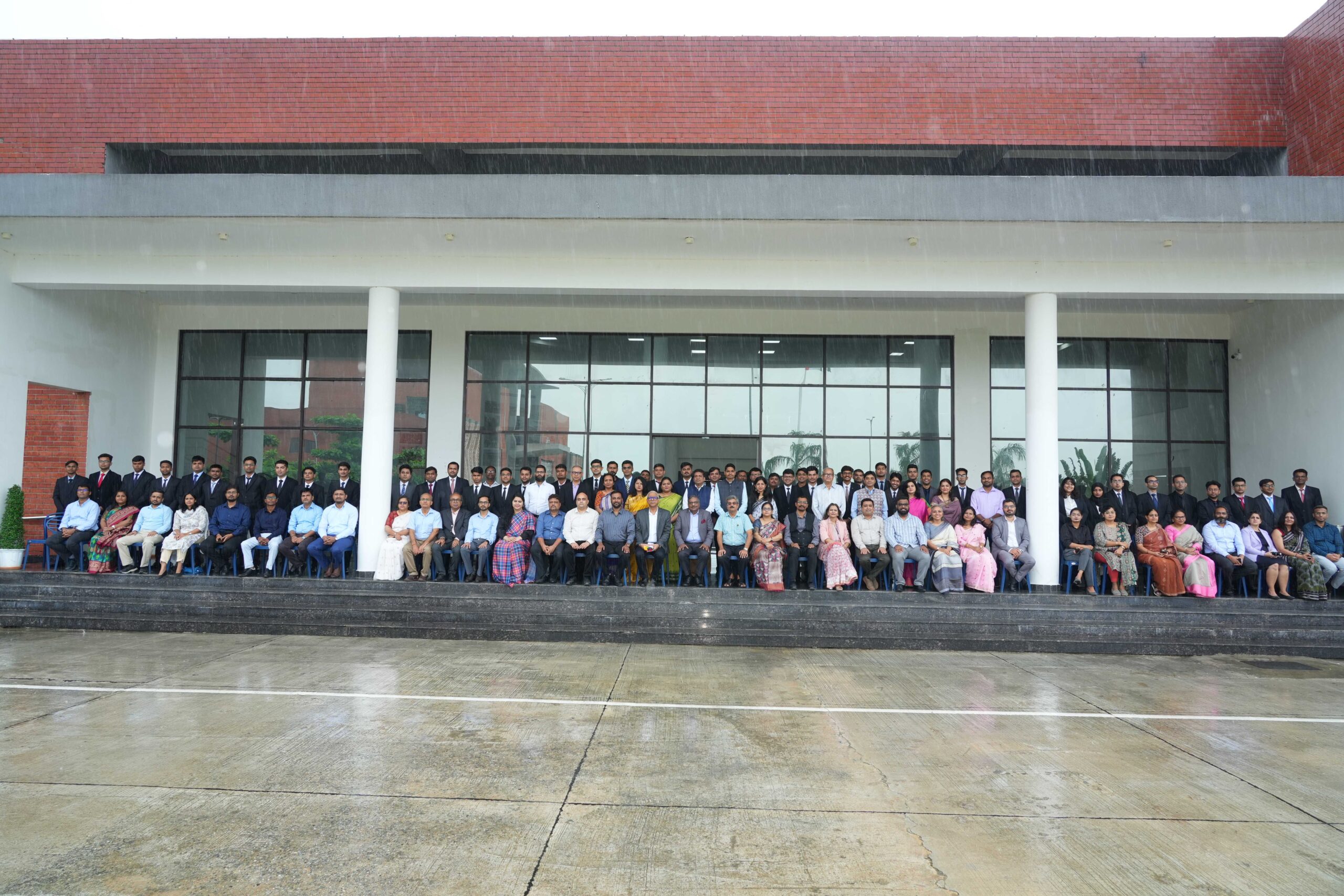
Eminent personalities including V. Srinivas, IAS, Secretary, DARPG, GOI as the Chief Guest; Rajiv Kumar, CEO, Vedanta Aluminium as the Guest of Honor; Samir Kumar, Country Manager, Amazon India as the keynote speaker and Prof. Mahadeo Jaiswal, Director, IIM Sambalpur along with the faculty members and Students were present in the inaugural ceremony.
During his welcome address focusing on sustainability, Prof. Mahadeo Jaiswal, Director, IIM Sambalpur highlighted the institution’s establishment by the Government of India in 2015 and said, ”India’s rise from the world’s 10th to 4th largest economy is a result of bold reforms like Digital India, Skill India, Startup India, and Make in India. At IIM Sambalpur, we believe it’s time to add one more, ‘Brand in India’. Our mission is to make Sambalpur the first sustainable city in India, for which we seek the help and support of the government. As a new-age IIM, we are contributing to this national vision by developing leaders who are not just job-seekers, but job-creators with entrepreneurial mindsets. Over the years, we’ve set benchmarks, from achieving near gender parity in MBA admissions to empowering traditional weavers through the Master Weaver program and introducing AI-enabled classroom discussions, an India-first, and possibly a world-first initiative.”
Further, he added, “Our three ’I’ values, Innovation, Integrity, and Inclusiveness, rooted in Indian philosophy, guide us in transforming education with a purpose. And our 3D action lens, Digitalisation, Decarbonisation, and Democratisation of business, ensures we are future-ready. IIM Sambalpur is not just producing managers, but responsible leaders capable of shaping and achieving the vision of Honourable Prime Minister Shri Narendra Modi of Viksit Bharat by @2047.”
Shri V. Srinivas, IAS, Secretary DARPG, GOI, said, “Across every sector, space, biotech, semiconductors, energy and robotics, India is witnessing an unprecedented technology surge. Our ‘Maximum Governance, Minimum Government’ approach is turning that momentum into citizen-first outcomes: 100% paperless central secretariat, the world’s largest AI-enabled grievance-redress platform, and deregulation that trims 20-plus outdated compliances so businesses can thrive.” Further, he added, “I’m delighted that IIM Sambalpur’s forward-looking MBA in Business Analytics mirrors this national journey, rooted in data, driven by innovation and shaped by ethical leadership. When students master digital tools, understand policy, and build entrepreneurial mind-sets, they don’t just analyse numbers; they design solutions that simplify lives, power industry and steer India toward a Viksit Bharat by 2047.”
Rajiv Kumar, CEO, Vedanta Aluminium, said, “After 35 years in industry, I can tell you: leadership isn’t found in a handbook, it’s carved by each of us from the inside out. Ask yourself every fortnight: what makes me mad, bad, sad, and glad? The answers will keep you honest while you sculpt your statue.” Further, he mentioned that, “Come out of your comfort zone, because that is very important to grow. Stay humble, hungry and hardworking. Add those three H’s to IIM Sambalpur’s three I’s of Innovation, Integrity and Inclusiveness, and the ‘CASH’ in your bank will rise, adding ‘KASH’ Knowledge, Attitude, Skill and Habit into your DNA and your life.”
Keynote speaker, Mr. Samir Kumar, Country Manager, Amazon India, while sharing his personal life experience he said, “From IT to Finance and Business, my journey has been very unique and adventurous. He advised students to work hard and to follow their passion, but not to deny that luck is a very important factor in everyone’s life for success.”
Earlier, the welcome address was delivered by Prof. Diptiranjan Mahapatra, Dean Academics. Prof. Siddharth G. Majhi, Chair, Admission, provided an introduction of the 11th Batch of MBA and 1st batch of MBA-BA, while the Introduction of MBA Programme was given by Prof. Shubhi Gupta, Chair, PGP and the introduction of MBA-BA Programme was given by Prof. Saumyaranjan Sahoo, Chair MBA-BA and an address, on AOL and IIM Sambalpur’s Accreditation Journey so Far, was narrated by Prof. Soumya Guha Deb, Chair, Ranking & Accreditation. The vote of thanks was delivered by Prof. Diwahar S. Nadar, Chair, SAC.
The day also witnessed the Orientation Programme for the MBA and MBA-BA cohorts, including a detailed briefing on the MBA Ordinance by Prof. Shubhi Gupta, Chair PGP and a briefing on the MBA-BA Ordinance by Prof. Saumyaranjan Sahoo, Chair MBA-BA, and Anti-Ragging policies by Prof. Rahul Sindhwani, Chair Anti-Ragging.
IIM Sambalpur is one of the premier management institutions in the country and is widely known for its quality education. Spread over approximately 200 acres of land, the breathtaking permanent campus of IIM Sambalpur was inaugurated by the Hon’ble Prime Minister of India, Shri Narendra Modi, on 3rd February 2024. The Prime Minister also laid the foundation stone on 2nd January 2021, via video conferencing. Furthermore, the Union Education Minister, Shri Dharmendra Pradhan, recently inaugurated the Incubation Centre, I-Hub Foundation, to promote startups and the ‘Rangavati Centre of Excellence in Cultural and Sustainable Management’. It also has tie-ups with Flipkart, Amazon, and SIDBI to support, promote and connect regional weavers with global platforms.
Equipped with sustainable practices and modernised facilities, the campus values its regional art by mapping the traditional IKAT, patterned textile-dyeing technique, onto the brick façade. The institute is committed to providing excellent management education, harbouring a sense of entrepreneurship, and developing socially responsible leaders. IIM Sambalpur is known for its two-year flagship MBA Programme, and admissions are held via CAT. It also offers an MBA for working professionals at the Delhi Centre at ISID, Vasant Kunj, providing options for a dual-degree Programme in partnership with French universities. Furthermore, in addition to the Executive MBA Programme, the premier institute offers a PhD, Executive PhD, and Management Development Programme (MDP).
IIM Sambalpur has played a torchbearer role for other IIMs in terms of gender-diverse classrooms. IIM Sambalpur cut-off is 92 percentile. IIM Sambalpur’s MBA fee is ₹13.04 Lakh, whereas IIM Sambalpur’s average package stood at ₹16.64 LPA, and IIM Sambalpur’s highest package stood at ₹64.61 LPA for the 2023 batch.