SUMMARY
- Wheelocity plans to expand to 20,000 towns in South India, reaching 10M customers.
- New funds will enhance technology, operations, and product teams for rural and semi-urban services.
- The firm competes with kiranas and haats, offering fresh products, a wider selection, and daily delivery.
Wheelocity, a supply chain network facilitator, has raised $15 million (₹126.5 crore) in a Series A2 round of fundraising, with Lightspeed VP serving as the lead investor. The company’s creator, Selvam VMS, Alteria Capital, and Anicut Capital also participated in the round.
With the help of this capital, the company hopes to reach 10 million customers by expanding to 20,000 cities and villages over the course of the following 12 months. It is presently active in Tamil Nadu and intends to grow into the states of Karnataka, Telangana, Kerala, and Andhra Pradesh in South India. Additionally, the company intends to diversify into non-food FMCG products, basics, household necessities, and other discretionary items in addition to vital categories like fresh produce and groceries.
In order to offer more effective and easily accessible services to semi-urban and rural customers, Wheelocity will also make investments to improve its technology stack. The business added in a statement that greater teams in category management, operations, product, and engineering, as well as technological innovations and a direct reach network, will support this expansion.
Selvam VMS and Senthil Kumar-led Wheelocity was founded in 2022 with the goal of resolving supply chain issues for new Indian commerce. The startup changed its business strategy in October 2023 after first launching as a B2B model that worked with e-commerce companies. Building an e-commerce platform for semi-urban and rural areas is the main goal of its current approach.
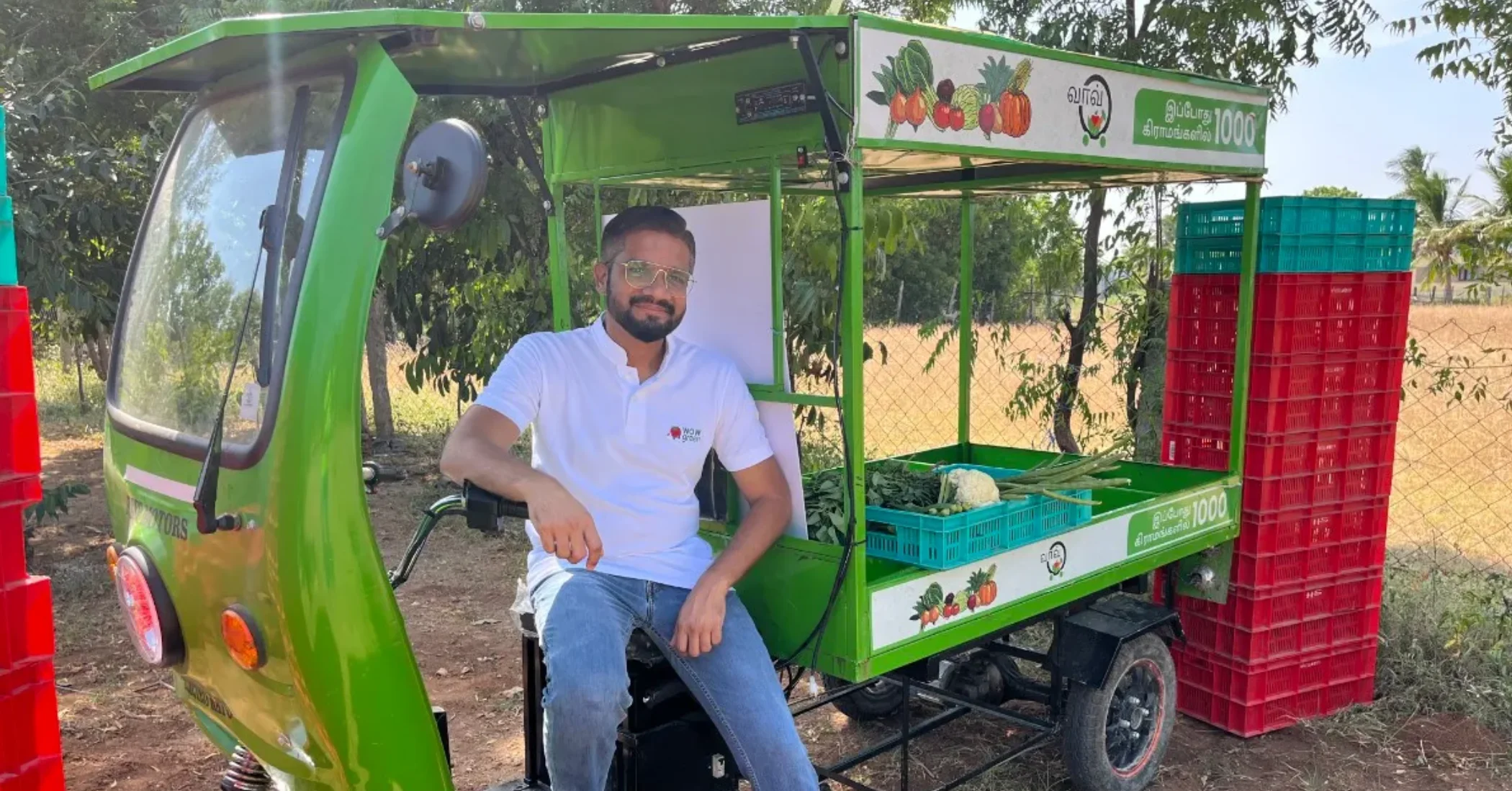
The company uses a “phygital” (physical plus digital) business model to cater to Indian semi-urban and rural clients, overcoming the lack of access to necessities in these regions. Using a high-frequency supply chain, the company currently distributes daily to cities and villages, specializing in fresh and food products. Customers can purchase straight from three-wheel electric carts that enter local communities or place orders through a mobile app.
According to Inc42, Selvam stated, “We reached product-market fit around February-March this year when we were present in just 30 villages. Now, we are present in 3,500 villages and have experienced significant growth. We have scaled up to 100X over the last six months. Our next goal is to expand to 20,000 villages within the next year. This offline presence builds trust with consumers, encouraging them to gradually shift to online purchasing.”
By offering high-frequency direct access infrastructure, Wheelocity hopes to alleviate these problems. It will begin with necessities and work its way up to discretionary categories.
The CEO claims that local kiranas and weekly haats are Wheelocity’s primary rivals. While local kiranas offer a limited assortment and freshness, weekly haats are only open once a week and require customers to travel three to five kilometers. Wheelocity, on the other hand, provides a better option with fresher products, a larger selection, doorstep delivery, and availability seven days a week.
In FY 2023, the business reported a loss of ₹12.56 crore with an operating revenue of ₹117 crore. The company previously raised $12 million in 2022 from Lightspeed and Anicut Capital, reaching a post-money valuation of $63.3 million.